Friday, February 20

Thursday, December 11
The Cerro Blanco Protected Forest 25 Years Young

The Pro-Forest Foundation which administrates the Cerro Blanco Protected Forest celebrated its 25th birthday with the participation of 985 visitors on Sunday, December 7th. The celebration revolved around the event ¨Festival of Nature and Culture¨ which included an eco fair with 25 stands promoting ecological projects and products with the participation of the Ecuadorian Ministry of the Environment, Environmental Unit of the Ecuadorian National Police, sister ecological groups such as Cerros Vivos and Amigos del Estero as well as vegetarian food and workshops on meditation among others.
During the day, a series of activities were carried out including a special event to commemorate Cerro Blanco´s anniversary led by Eric Horstman, Pro-Forest Foundation Executive Director as well as Camila Morales delegate of the Municipality of Guayaquil´s Tourism Department and Mr. Andres Aspiazu representing the family of one of Cerro Blanco´s founders Eduardo Aspiazu X, former President of the Guayaquil chapter of Fundacion Natura, which along with La Cemento Nacional (now Holcim Ecuador) worked to create the Cerro Blanco Protected Forest. Andres Aspiazu led the participants in a toast to Cerro Blanco and happy birthday sung with birthday cake distributed to the participants.


Workshops on different themes such as recycling and composting were carried out as well as special activities for children including games and art about the conservation of birds and bats among other topics. Guest speakers gave presentations on the dry tropical forests and the birds of the Tumbesian Bioregion. Cerro Blanco´s dedicated group of guides led visitors on walks in the forest throughout the day.


Artistic presentations including a puppet show and music were very well received by visitors as well as yoga and Indian traditional dancing.
The event also marks the official inauguration of Cerro Blanco´s new installations including camping and picnic area, trails and interpretative signboards.
Wednesday, December 10
Monitoring nest boxes at Bosque Protector Cerro Blanco during the bird breeding season 2014 for management of the avian parasite Philornis downsi
The main objective of this study was to find out if
the parasitic fly Philornis downsi,
which is an invasive species accidentally introduced into the Galápagos
Islands, occurs naturally on mainland Ecuador. In order to do this, we needed
to observe bird nests after the birds finished rearing chicks and abandoned it.
An easy, well-established method to follow bird reproductive behavior consists
of installing wooden nest boxes with a side door that can be opened and the
inside nest (and bird activities) easily monitored. The Bosque Protector Cerro
Blanco is the perfect place for this study given its high bird diversity.
.jpg)
.jpg&container=blogger&gadget=a&rewriteMime=image%2F*)
Nest box set in the trunk of a tree in Cerro Blanco with a Streak-headed Woodcreeper standing on it.
On
November 2013, a team of biologists from the University of Minnesota (USA),
Universidad Nacional del Litoral (Argentina) and Universidad de Guayaquil (Ecuador)
installed a total of 158 nest boxes inside the perimeter of the Bosque
Protector Cerro Blanco.
Between January and June 2014, the nest boxes were
monitored weekly in search of any sign of bird activity (nest construction,
incubation, tending to the chicks, etc.). Many of the boxes were not occupied,
as is normal during the first year in most studies. It takes time for the birds
to get used to the presence of the nest boxes and actually use them. In some cases,
nests were constructed inside the boxes but they were abandoned. In only four nest
boxes, birds laid eggs and fledged chicks.

Nest constructed inside a nest box.
On March 1st 2014, we found five House Wren (Troglodytes aedon)’s eggs in a nest box.
Five nestlings hatched but only three nestlings remained on March 22nd,
they fledged on March 29th. We found 8 Philornis pupae in the nesting material. After examination under
the microscope in the laboratory, we confirmed the presence of Philornis downsi in mainland Ecuador.

House Wren nestlings in the nest. On the bottom right there
is a
Philornis downsi puparium.
Our study recorded two new host species for the
genus Philornis: the Fasciated Wren (Campylorhynchus fasciatus), a common
species restricted to western Ecuador and northwest Peru where it principally inhabits arid and semi-arid
habitats; and the Streak-headed Woodcreeper (Lepidocolaptes souleyetii), a furnariid
found in Central and Northern South America. Our data
indicate that Philornis downsi occurs
naturally on mainland Ecuador and is relatively abundant in the vicinity of
Guayaquil. Cerro Blanco is located approximately 15 km from the Guayaquil
airport and 20 km from the Guayaquil harbor. These data support the hypothesis
that P. downsi could have been
introduced to the Galápagos from mainland Ecuador.
Wednesday, August 6
Two forests walled in by the growth of Guayaquil
Sunday, July 27, 2014
One coexists together with the other in between roads, parks, housing
developments, wharfs and even mining exploitation. On one side, one grows fragmented in
wasteland or in the high parts of the hills.
The other side, the canopy of its trees rise up along the borders of the
branches of the estero Salado (saltwater estuary) as a dense mass of
vegetation.
Both are the home of birds such as the Red lored Amazon that in the
morning flies in flocks in search of food in the higher parts of the Cerro
Blanco Protected Forest and in the evening come down to sleep in the foliage at
the foot of the brackish waters of the estuary in Puerto Hondo. They are the dry forest and mangroves, two
ecosystems that in the past dominated the geography of what is today the urban
zone of Guayaquil and that coexist divided by the via a la costa, the new axis
of growth.
Of the two ecosystems that characterize the natural zones of this city,
the dry forest is more fragile because its species of flora grow slower, is
easily accessible and is being strangled or fragmented by urban expansion.
A report as part of a consultancy prepared by Eric Horstman,
administrator of Cerro Blanco and presented in December 2012 to the Ministry of
the Environment, established that the areas that have some type of protection
in Guayaquil face threats such as hunting, tree cutting to make furniture or
charcoal, the burning of forests to later plant crops and invasions (squatter
settlements).
The report identifies the possible impacts such as the construction of
new roads that isolate more areas like Cerro Blanco, threatened also by mining
due to its proximity to ¨the mine quarries with blasting and the production of
dust that affects the flora and fauna¨, according to the report.
Horstman asserts that there lacks awareness in the citizenry about the
value of dry forest. ¨There is the idea
that a park should always be green and the types of plants that are used
require constant irrigated water, without taking advantage of the surrounding
conditions¨, he said.
The dry forest contains species that could be used with tourism value if
they are integrated in the green spaces of the city, which would give a
distinct character to the metropolis, with the presence of trees such as
guayacanes or the pigios, according to Horstman.
He mentions an example of this in Rio de Janeiro (Brazil), the city that
shelters the Tijuca National Park, and a forest where the Christ Redeemer
monument was constructed.
In Guayaquil there are 1,892 hectares of green spaces including traffic
dividers, parks, plazas, playing fields, riversides, gardens and cemeteries,
according to the municipality.
Another problem is that the ecological functions of both ecosystems have
not been made used of for development.
The native trees of the dry forest for example have leaves that end in
points so that rainwater drips off gradually, avoiding erosion, says Nancy
Hilgert, environmental consultant. Here
what has remained in a natural state I believe has been more of an accident
than as an objective, sustains Horstman.
The mangroves on the other hand have the function to act as natural
barriers against flooding, affirms Mireya Pozo, a specialist on this ecosystem.
The processes of filling (in the mangrove) to urbanize zones such as el
suburbia, isla Trinitaria and Las Malvinas in the south of the city and Urdesa,
Mapasingue and La Prosperina in the north, exterminated the largest part of the
mangrove forest that 50 years ago had an extension of 655 hectares according to
investigations carried out by students of Public Communication of Science and
Technology (Department) of the ESPOL (Escuela Superior Politecnica del
Litoral). Pozo says that at least 40% of
the city sits on what was formerly mangrove forest, in a scenario decades ago
when there was less consciousness of the value of this ecosystem.
Mauricio Velasquez, ex Director of the Environment Department of the
Municipality of Guayaquil is concerned about the carrying out of extractive
activities near protected areas such as Cerro Colorado, from which gravel, rock
and clay are extracted for fill. They
destroy hills leaving 90-degree slopes to take out material to fill the banks;
¨ says Velasquez, referring to rivers such as the Daule, which extends to
another of the almost disappearing ecosystems, flooded plains.
The installation of housing developments and wharfs or parks along the riverbanks
are carried out without taking advantage of the function of mangroves to
control flooding. This is evidenced in
sectors such as Las Malvinas in the south of the city, where the Government
constructed a wharf on the edge of the estuary and planted trees from another
ecosystem for ornamental purposes.
Discharges to the estuary
In addition, another threat remains to be resolved, the discharge of
domestic and industrial residual water to the estuary that affects the mangrove
ecosystem. There are complaints that the
treatment plants for sewage in the housing developments in the via a la costa
do not function in an adequate manner, ¨ says Velasquez.
The felling of trees and fill affects the flow of water that these trees
need. This stress makes the mangroves
susceptible to pests¨, he added.
The falling down of mangrove trees in distinctive points of the city is
evidence that they are sick although there are a lack of studies to verify the
causes of this phenomena, concur Hilgert and Horstman.
Perfecto Yagual, head of the park guards of the Cerro Blanco Protected
Forest, one of the last remnants of the dry ecosystem that skirts the western
part of the city has observed how the natural areas have been transformed. He arrived in the zone of the via a la costa
in 1958 coming from Libertador Bolivar, in Santa Elena. He says that at that time, the dry forest
began to compete with pastures in the farms that were foreign owned, such as
the Hacienda Palobamba. Despite the
pastures, peccaries, birds and deer where seen along the borders of the
highway. Now one has to go into the
higher areas to see them¨, says Yagual, who remembers when it was common to see
in the streets of Guayaquil the sale of fruits such as caimito, which was
extracted from the forest.
http://www.eluniverso.com/noticias/2014/07/27/nota/3282036/dos-bosques-cercados-urbe-que-crece

Friday, August 1
Green proposals in favor of Guayaquil
Sunday, July 27, 2014
While walking through patches of dry forest in Guayaquil in the high and
deep part of the Cordillera Chongon-Colonche and let a canoe lead you on the
calm current of one of the estuaries of the estero Salado that coexist with
mangrove forest, Nancy Hilgert and Eric Horstman not only remember how these
ecosystems were when they arrived in the city 38 and 24 years ago respectively,
they also expound measures that they consider if applied could save these areas.
They are familiar with the howl of monkeys that from a distance announce
that the dry forest is their home, with the crackling of the large maroon
colored leaves that every six months the trees of this ecosystem drop to
survive the dry season, as well as the smells, somewhat rotting of the
saltwater estuary.
Although they weren´t born in Guayaquil – Eric is American and Nancy was
born in Peru but became a naturalized Ecuadorian, have dedicated themselves to
the conservation of these natural areas, Horstman the dry forest through the
Pro-Forest Foundation that administers Cerro Blanco and Hilgert both dry forest
and mangroves from a professorship, diverse NGO´s and public appointments.
This newspaper invited them to traverse these natural areas in order to
evaluate them. In the visits proposals
came out to restore the areas, which according to Hilgert ¨is a necessity to improve the quality of
life of Ecuadorians¨. This was said
while the canoe advanced through the estuary bordered by mangroves where
cormorants, mangrove warblers and herons are seen.
Both propose connecting the protected forests that have become isolated
in the middle of the city and to do that they propose options including canopy
bridges (connecting portions of the forest through the tree canopy),
subterranean tunnels so that terrestrial fauna can move through and regenerate
zones that make up ecological corridors.
One is connecting the Cerro Blanco, Papagayo de Guayaquil, La Prosperina
and Cerro Paraiso Protected Forests with the Cordillera Chongon-Colonche.
Another possible connection they say is to integrate what remains of
Cerro Colorado where the botanical garden functions with Los Samanes National
Recreation Area. This could be achieved
through reforesting a parcel that borders the Los Geranios housing development.
An action that could be applied for the conservation of both ecosystems
is reforestation or ¨restoration¨, as Horstman prefers to call it.
This forester says that in the case of dry forest, reforestation could
be done with introduced species such as eucalyptus and teak, but restoration
requires instead, endemic species such as pigio, ceibo, Amarillo and
cocobolo. With this, what is returned to
the city is what was formerly found there, which was cut down to drive urban
development.
As for the conservation of the mangrove forest, Hilgert sustains that
the current environmental legislation must be reformed to establish permissible
limits to the discharges of residual waters (sewage) to bodies of water, which
currently does not establish quantities (volume of discharges).
On this point, both agree that closing ¨the faucets of contamination¨
the estero Salado receives, the mangrove forests can be saved.
According to Horstman, restoration can also be done on adjacent lands to
the mangroves to extend them and on the higher land plant dry forest to re
establish the connectivity that once existed between the two areas.
In Puerto Hondo, he says trees such as pechiche have been seen to extend
down to the waters edge, which means that dry forest once was found down to the
edge of the mangroves.
http://www.eluniverso.com/noticias/2014/07/27/nota/3282016/propuestas-verdes-favor-ciudad?&utm_source=facebook&utm_medium=social-media&utm_campaign=addtoany

Thursday, July 31
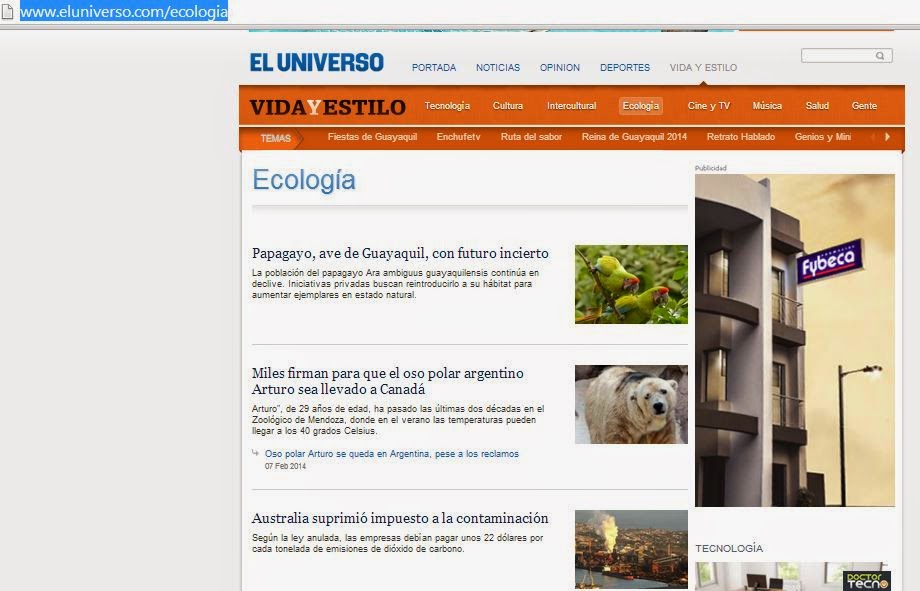
Macaw, symbolic bird of Guayaquil with an uncertain future
El Universo, Sunday, July 20, 2014

With a ´national conservation strategy´ and having been declared by a
municipal ordinance the natural symbol of the city has not permitted
maintaining or improving the population in its natural state of the Guayaquil
Macaw (Ara ambiguus guayaquilensis),
in critical danger of extinction and that tomorrow, July 21st is
commemorated as the Day of the Guayaquil Macaw.
This subspecies of the great green macaw (Ara ambiguus) is distinguished by its brilliant green plumage and
in its wings light up with turquoise blue that at the tail mixes with
orange. Before the beak begins to
curve, a red crest projects out.
In 2005, the year that the ´in situ (in its natural habitat)
Guayaquil Macaw´ National Conservation Strategy was released and updated and changed to ´Great
Green Macaw National Conservation Strategy´ in 2009 as well as municipal
council ordinance were expedited as protection measures, the Ecuadorian
population of this rare bird was estimated at between 60 and 90 individuals or
20 to 30 pairs in the natural state.
Eric Horstman, executive director of the Pro-Forest Foundation,
institution situated in the Cerro Blanco Protected Forest and has diverse
programs and actions to guarantee the future of the bird, estimates that now
there are between 40 and 50 individuals remaining in the wild.
The dry forest of the Cordillera Chongon Colonche and the humid forest
of Esmeraldas Province are the two principal habitats of this species, but they
are in danger because of deforestation and hunting.
In captivity survive 53 individuals, the product of confiscations, and voluntarily
handing over macaws to wildlife rescue centers and zoos in the country. They are distributed in ample cages in Cerro
Blanco, the Guayaquil Historic Park and the Jambeli Rescue Foundation Center,
that has worked since 1996 in the ex situ
(outside of its habitat) conservation and captive reproduction of the bird.
This measure according to Joaquin Orrantia Vernaza, Director of Jambeli
Rescue is a viable alternative for the recuperation of endangered species such
as the Guayaquil Macaw. Captive reproduction also permits the eventual
reintroduction of the species in its natural habitat, which according to
Horstman, will help in increasing the population of Ara ambiguus
guayaquilensis.
The biologist Mauricio Velasquez, who was the impetus behind the
declaration of the bird as the symbol of the city during his time in the
municipal environmental direction coincides in that macaws should be
reintroduced in some patches of vegetation with adequate protection and follow
them with radio telemetry (technique for measuring distances with radio
transmitters and receivers) which is done with condors in the Andes region.
However, Horstman says that there is still much work to be done to
¨prepare the playing field¨ so that when macaws are liberated, conditions are
apt and they will survive. Without these
guarantees, the six birds that would be reinserted in Cerro Blanco are waiting
to someday fly free.
The principal limiting factor for any initiative of this kind according
to the sources that were consulted is the lack of a budget.
Without funds, says Horstman a more extensive monitoring of the species
cannot be carried out, a key point of the ´national conservation strategy´
which ¨is somewhat moribund¨.
Orrantia believes that in order to set out a successful path towards the
survival of the species, there needs to be a sufficient reduction or total
elimination of the threats the species faces.
This can be achieved with integrated strategies and acting in a
coordinated manner towards the same objectives, including the general public in
the process so that they will be concerned about their local environment and
not buy these birds that according to Velasquez can cost up to depending on the
country between $2,000 and $3,500 dollars each.
In previous rainy seasons deep in the forest a lone flock of up to 11
macaws could be seen, but in the last three or four years this has not been
possible.
The 6,078 hectares (of the Cerro Blanco Protected Forest) are not
sufficient to guarantee the survival of the species. ¨Cerro Blanco is becoming an island. Its not that you leave the protected forest
boundaries and find other forest remnants but instead you find housing
developments and quarries that often do not permit the species to leave or if
they do, they die. Where we still have
connectivity is in the eastern part towards the via a la Costa, we are working
to implement a biological corridor to connect the patches of forest¨, indicated
Horstman, who began to work in the area 24 years ago when the last housing
development was Puerto Azul and where it was normal to still see the cities´
symbol flying free.
That the area be recognized as a biological corridor might not occur if
the construction of alternate highway to the via a la Costa, because it would
go through the Cordillera Chongon Colonche.
Another problem is that some of the owners of the nearby plantations see
the Guayaquil Macaws as a plague that eats their crops. In addition to eating the seeds of the
cocobolo tree, the bird eats corn on the cob when it is still green. The agriculturalists shoot the macaws to
avoid losing their cornfields, refers Horstman.
Others cut down the pigio, the preferred tree in Cerro Blanco for the
bird to nest in.
They see the tree as a threat to their lands, because within the trunk
of the tree, the wood is similar to balsa, soft and spongy, a characteristic
that the agriculturalist translates into the cause of droughts, when in fact it
is only a strategy to store water reserves during winter rains and to be able to
maintain the tree alive during the dry season.

Wednesday, July 9
The Natural Symbol of Guayaquil Is Going Extinct
By Mauricio Velasquez

For those that don´t know, the city of Guayaquil has a symbolic bird,
its most distinguished brand, the Guayaquil Macaw. It is a sub species of the Great Green Macaw
that is endemic to the coast of Ecuador.
The distribution range of the population is very reduced and it is in danger
of going extinct. This grave state is
caused by the high deforestation rate of dry tropical forest and its continued
burning to ¨clear the land¨ to carry out unsustainable agricultural
practices. The macaws are captured for
their illegal commercialization and they are often sold in both local and
international markets. All of these
factors have the bird symbol of Guayaquil against
the ropes as we say in boxing terms and at the point of a fatal end. It is estimated that only 30 to 40 individuals
currently remain in their natural state.
The progress of Guayaquil destines them to die. Nobody is unaware of the urban growth in the
coastal highway, where besides the housing developments that surround the
Chongon Cordillera, are also found countless mine quarries that diminish the
area of the forest in its hills. Sites
where our symbolic bird lives. If it
wasn´t enough, the connectivity of the macaw´s habitat will be also lost for a
project that is working silently and plans to construct a new periphery highway
in Guayaquil through the western boundary of the Cerro Blanco Protected Forest
and cut the biological corridor linking Cerro Blanco with the Chongon and
Colonche Protected Forest.
In 2005, the National Conservation Strategy in situ for the Guayaquil Macaw¨ was promulgated. In the same year, the Municipality of
Guayaquil issued an ordinance that declared this animal ¨the natural bird symbol of the canton¨ in
addition to being the flagship species for dry tropical forest conservation
programs within the boundaries of the canton.
Later, a inter institutional work group was formed (where, although it
sounds strange now, the Ministry of the Environment and the Municipality worked
together) to initiate conservation actions, among them, the signing of a
cooperation agreement between the Municipality of Guayaquil and the Pro-Forest
Foundation to:
- Consolidate the Declaratory of the Protection of the Guayaquil Macaw (Ara ambiguus guayaquilensis) through the monitoring of the state of the populations.
- Elaborate a Forest Fire Prevention Plan.
- Reintroduce and monitor individuals of the Guayaquil Macaw (Ara ambiguus guayaquilensis) born in captivity in the Cerro Blanco Protected Forest.
- Train professionals in the management of natural protected areas.
- Implement conservation activities for wildlife through the strengthening of wildlife rescue centers.
However, the year after the signing of the agreement (2009) the head of
Environmental Planning in the Municipality of Guayaquil and its Environment
Director, changed their priorities for action and let this important
conservation initiative wilt, sentencing in this way, the destiny of the
species.
Despite this, the Pro-Forest Foundation, one of the last Mohicans of
conservation in Guayaquil continues practically alone in its efforts to
prevent the extinction of the Macaw and has carried out reforestation efforts
in more than 250 hectares in Cerro Blanco with 35 native tree species, many of
these plants have fruits that constitute the food base of the symbol of Guayaquil in its natural
habitat. Although this work is
important, it does not guarantee that the macaw won´t go extinct.
As a Guayaquileño, I´d like a consultation to be made to the citizens of
Guayaquil in which they are asked if they are in agreement that the extinction
of the Guayaquil Macaw is carried out.
And at the same time, this consultation also is made with the principal
national, provincial and local environmental authorities.
The first step in order to act is recognizing the problem and really we are not doing anything to prevent
Guayaquil from losing its natural symbol.
http://www.cre.com.ec/noticia/63220/se-extingue-el-ave-simbolo-natural-de-guayaquil-2/
Subscribe to:
Comments (Atom)